


.webp)



.png)















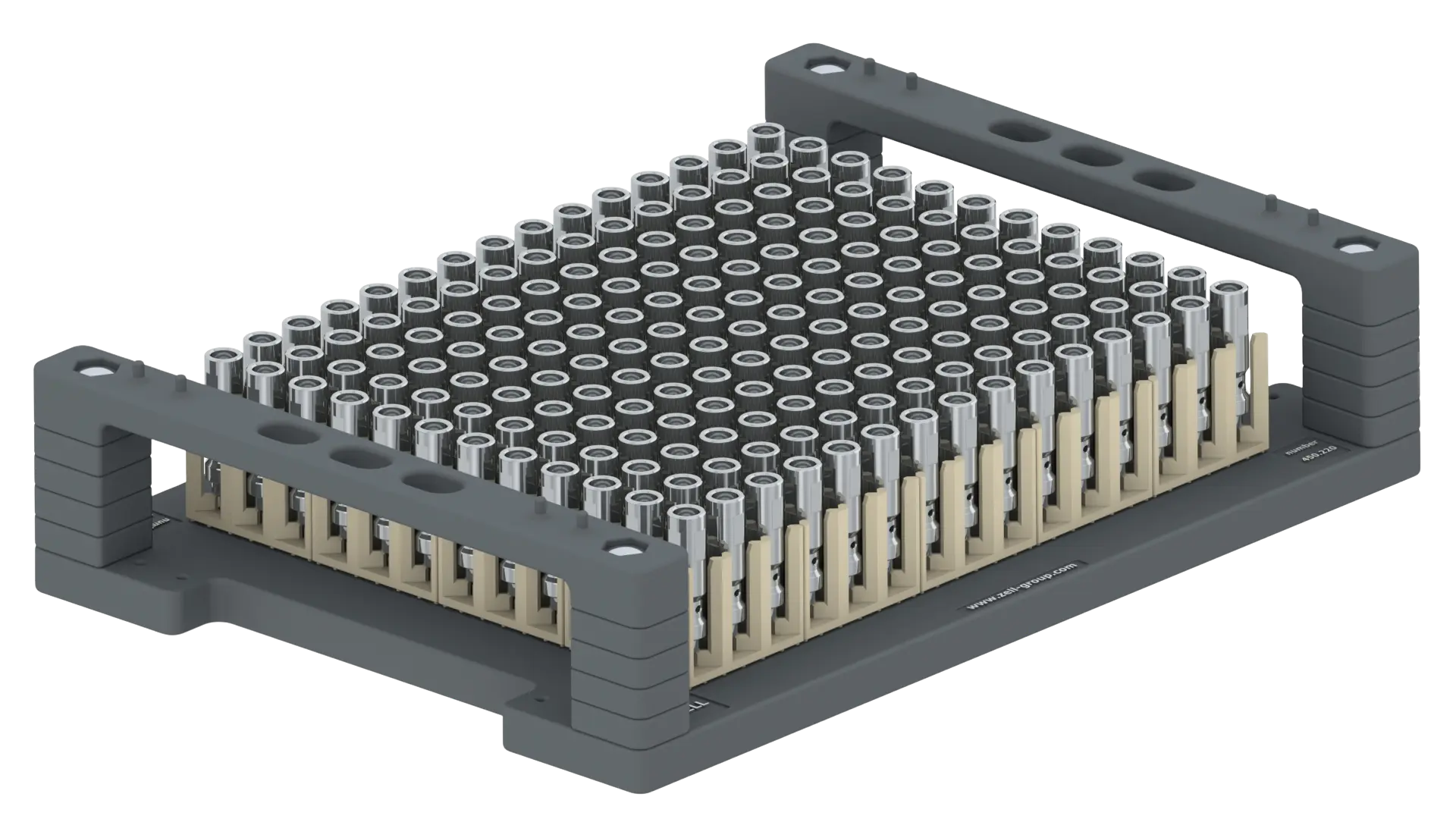
In modern manufacturing environments, workpiece carrier systems play a key role in determining efficiency, component protection and automation capability. However, not all technologies meet the increasing requirements for traceability, variant management and process integration. Compared to conventional systems such as foam inlays, thermoformed tra ys and wire cleaning baskets, the modular workpiece carrier systems from the ZELL Group(www.zell-group.com) offer significant advantages.
Advantages:
Disadvantages:
Conclusion: Suitable for prototyping or one-off transports - but inefficient in automated series processes.
Advantages:
Disadvantages:
Conclusion: Useful for constant quantities and geometries - but quickly costly for flexible production.
Advantages:
Disadvantages:
Conclusion: Ideal for simple cleaning runs - not suitable for reliable series production or automated lines.
The workpiece carrier systems from the ZELL Group combine the advantages of all systems - without their weaknesses.
Typical advantages:
ZELL systems are successfully used by manufacturers such as Müller Präzision, NTK, SFS, medical technology companies, automotive OEMs and defense suppliers - worldwide, series-tested, modular.
In a production environment that balances robotics, cleaning, logistics and variant handling on a daily basis, there is no alternative to modular carrier systems. The systems from the ZELL Group ensure reproducible quality, short changeover times and digital traceability - with an economical and future-proof platform approach.
Request a CAD example or test carrier now.
Depending on the application, we recommend starting with our "Factory" workpiece carriers, as these can be configured both as inserts for Euro containers and as standalone functional carriers. More demanding applications are better suited to our reinforced "Carrier" or "Stainless Steel" carriers.
Yes, all carriers are washable. Samples can be provided for specific critical process parameters.
Yes, all workpiece carriers are compatible with automation systems, form a defined matrix, and can therefore be configured for robotic use. Components are arranged in such a way that grippers can be positioned accordingly. Because the carriers are designed to be cleanable, they are slightly heavier; therefore, their weight and center of gravity must be taken into account when handling the entire carrier.
Our plastic carriers operate reliably over extended periods at temperatures of approximately 60–70°C, and in some cases even at significantly higher temperatures during short cycles. Our stainless steel carriers—particularly the GRID carriers—can be used in furnaces at temperatures up to 1,200°C. For additional specifications, please refer to our material data sheets.
Yes, all plastic components can be manufactured with an antistatic additive. See also the data sheet in the Downloads section.
Yes, ZELL can custom-manufacture component holders, as well as entire workpiece carriers or inlays for containers, as a single injection-molded component. We typically start by reviewing the more than 1,300 available variants using our ZELL configurator; if no satisfactory solution is found there, customers can work with our engineering team to develop a “new clip.” These can be tested in 3D and as prototypes before the corresponding injection mold is manufactured.




.png)


