
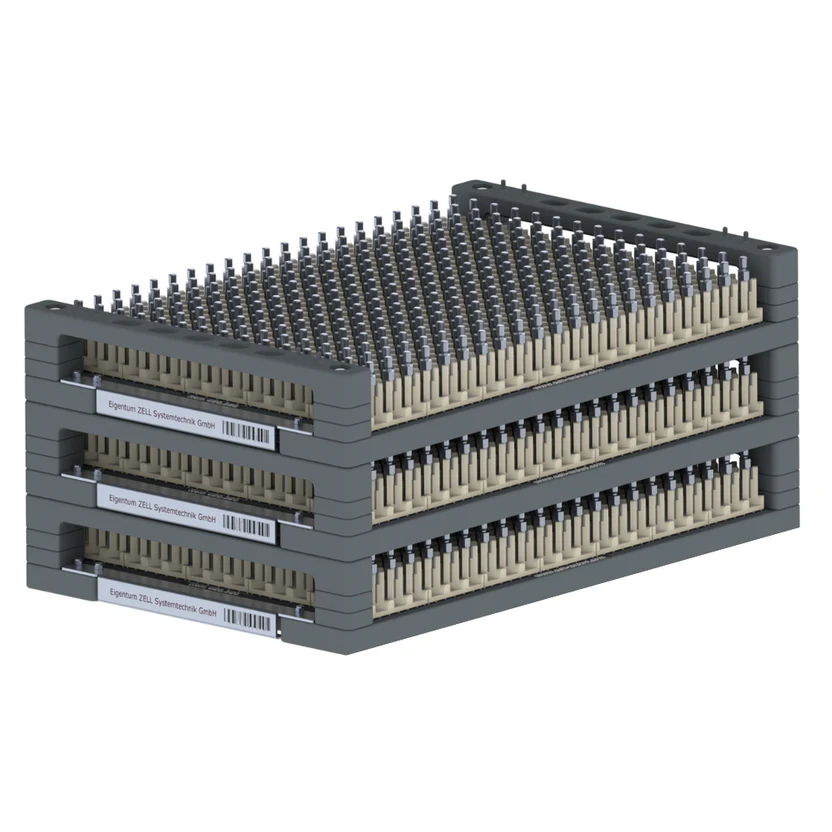
Defined cavities on trays enable fast and precise picking processes. Precision components can thus be optimally handled, processed, and assembled in batches.
Send your request


Modular trays, standardized with a defined matrix. Adjustable in less than three minutes.
Compatible with QR or barcodes, RFID, and Auto-ID systems. Adaptable to existing automation systems.
Precise placement in protective plastic clips, optimally positioned for grippers and handling systems.
%20(2).webp)
ZELL systems are used wherever components need to be automatically handled, positioned, and transported – for example:
Cost Factor: Time
Automated production works best when the same component is always located in exactly the same position. This simple indexing within a defined matrix saves significant time—especially across multiple production steps.
If an industrial robot had to perform “bin picking” at every production stage because components are supplied in a semi-structured or chaotic manner, three steps would always be required:
Detect and analyze the structure of the parts using a vision system and identify the position of each individual component.
Transfer the image-processing data to the robot controller and calculate the optimal path, gripping, and extraction strategy.
Place the component at a predefined position or transfer it to the next production step.
No matter how powerful the computing performance, this process takes time. It therefore makes sense to complete this step at most once—and then consistently present the automation system with the same structured component layout. That is Lean Production.
Cost Factor: Money
In production, time equals money. But there is another decisive factor: scrap. Producing lower-quality parts (B- or C-grade goods) creates direct financial losses. If a manufactured component cannot be assembled or sold, the company must book a loss—contradicting the principles of successful lean production.
With a custom tray system, components are not only secured but also transported gently throughout the entire process chain. Especially when using individual component holders (clips or multi-clips), physical contact between parts is virtually eliminated. As a result, surface quality is preserved until the final stage of production.

Manufacturers of precision and small parts with automated production processes can transport components either in bulk within containers or individually. Thanks to their clearly defined placement matrix, precision trays offer significant advantages for automation.
Production companies typically begin by transporting parts in low-cost boxes. However, these are difficult to integrate into automated processes. While a worker can easily pick a part from a box, for a robot “bin picking” is a highly computation-intensive task. Ongoing advances in camera technology, sensor systems, and software have already led to effective solutions for separating parts from containers. Nevertheless, each of these methods remains slower than the clearly defined, single-piece feeding of components in a parts carrier.
Trays with compartments enable efficient handling of larger batches of parts. As automation processes become more complex, the next step often involves complete singulation of the components. These are then typically handled directly within the production line or machine.

If defined placement positions already exist—for example through blister trays into which parts must be re-batched—it is generally necessary to develop equivalent custom trays. The same applies to existing automation processes. If, for instance, an industrial robot has already been programmed for a specific handling method, it may be more cost-effective to adapt the tray to these conditions rather than reprogram the automation system.
In cases where specific external dimensions are required that cannot be configured using ZELL standard components, a custom stainless steel tray must be manufactured to meet the corresponding specifications. In such cases, development costs are significantly lower compared to plastic solutions, while the material costs are correspondingly higher.
Therefore, it is common practice for manufacturers to use tailored stainless steel trays combined with plastic inserts or clips for customized solutions to ensure optimal process reliability and efficiency.


Again and again, there are also individual requests from customers. For example, ZELL has already developed a suitable solution for the existing cleaning system. Individual trays can be inserted flexibly in height via integrated plate elements. This means that a wide range of Parts can be covered without the need for costly conversion work. The basket material is made of V2A, 1.4301 with electropolished surfaces. Cleaning baskets in this form are suitable for industries with very large components that vary in shape.
More about our cleaning baskets for large components
Improved safety
Standardized cleaning baskets have safety features such as handles, locking mechanisms and ergonomic designs. These features facilitate safe handling, transport and loading/unloading of Parts, both in automated processes and manually. In addition, standardized baskets undergo extensive testing to ensure compliance with relevant safety standards and minimize the risk of accidents or injuries during the cleaning process.
Cost savings
Standardized cleaning baskets offer cost advantages compared to individual solutions. Because of their standardized design, they can be produced in larger quantities in stock. This usually results in lower unit costs and offers a more favorable alternative, especially for customers with large production runs.
Clear identification of all Parts to be washed
Cleaning baskets from ZELL can optionally be ordered with identification holders. RFID chips can be attached to these or bar or QR codes can be lasered in. These enable the unique identification of Parts during the entire cleaning process in real time and thus contribute directly to quality management.
Sustainable maintenance options
In addition, the standardized design of modular cleaning baskets simplifies maintenance and repair procedures, as individual spare Parts or components are readily available and interchangeable. This also makes ZELL's baskets a sustainable alternative to existing basket systems.
Our systems can be equipped with RFID, DMC, or laser codes – enabling complete component traceability and seamless integration into MES and ERP systems.
The modular design of ZELL systems ensures consistent indexing of the entire custom tray assembly. Since a matching tray and basket exist for every clip, the position of each individual component remains traceable and calculable for all machines and industrial robots, even throughout complex process steps.
For example, if a turned part is manufactured on a CNC machine, measured, and placed onto a tray, then inserted into the corresponding basket and washed as a complete batch, the exact position of each individual part can still be identified afterward.
Each custom tray and basket can be uniquely identified via an attached labeling holder with a QR code or RFID chip.
Many customers already work with automation partners who can fully integrate these systems. Together with partners such as TURCK, we also provide complete project planning and implementation support.


.png)


